Showing posts with label A24 Films. Show all posts

Tuesday, 17 September 2019

Film Review: The Farewell

"Chinese People Have A Saying; When People Get Cancer, They Die..."


First released to the public at this year's Sundance Film Festival to overly positive critical and audience reviews, The Farewell comes to British cinemas this week with an impressively widespread general release, particularly for a movie which predominantly relies on the use of subtitles, an art of which the lay cinema fan still seems to strangely shy away from. Directed and written by Beijing born filmmaker, Lulu Wang, The Farewell is a comedic drama based in-part on her own experience involving her elderly grandmother who was hidden from the truth of her terminal cancer diagnosis by her own family, a decision of which in Chinese culture is apparently relatively common and surprisingly lawful. Portrayed as a sort of indie inspired, heartfelt comedy from its' supporting trailer, Wang's movie is indeed an interesting, minimal and contemplative piece, one which takes much pleasure in exploring a particular culture completely alien to that of most Westerners including myself, but with a strangely flat pacing and a onenote idea which runs out of steam come the hour mark, The Farewell is clearly a project made with an abundance of passion, but as a film, failed to completely draw me in on an emotional level and thus come the final hurdle, becomes slightly benign and immediately forgettable. 


Following up from interesting supporting performances in the likes of Ocean's 8 and the vastly superior cultural comedy, Crazy Rich Asians, Awkwafina this time takes the lead role as Billi, the supposed fictional stand-in for Wang who upon hearing about her family's decision to hide the traumatic news from her grandmother, Nai Nai, played in a rather excellent form by Zhao Shuzhen, takes the long trip over to China in order to engage in a makeshift family wedding, a particular event used as an excuse for the family to reunite in order to see their beloved matriarch for potentially the final time. With the comedic quips minimal in favour of long, drawn-out shots of contemplative nothingness, the pace of the movie does feel bafflingly lifeless, and even when at the heart of the story is a plot device which should naturally woo the hearts of even the sturnest audience member, the truth is that at no time did I really care about anyone on-screen throughout the course of a hundred minutes which in all honesty, felt closer to the two hour mark, a negative aspect if ever there was one. With my mind not fully engaged therefore, the excellent performances do sort of become taken for granted, whilst the interesting cultural examinations don't really make any real difference, and with a concluding act which doesn't make any narrative sense and sort of makes the entire point of the movie completely pointless, Wang's movie is clearly made with a lot of heart, but it still lacked that key ingredient you need from a drama; drama. 

Overall Score: 6/10

Saturday, 6 July 2019

Film Review: Midsommar

"It’s Sort Of A Crazy Festival. It Only Happens Every Ninety Years. Special Ceremonies And Drinking And Dressing Up..."


After a variety of thought provoking and acclaimed independent short films, director Ari Aster burst into the spotlight for audiences and critics alike last year thanks to the release of Hereditary, the spine-tingling work of desolate dread which will forever remain as one of the most terrifying experiences I have had to endure within the confines of the cinema during my life so far. As per the remit of any good filmmaker, Aster's decision to not milk the praised poured upon him for too long results in his swift return in the form of Midsommar, a film of which Aster himself proclaims as his first "true" horror movie after declaring Hereditary nothing more than a "family drama", albeit the most unhinged and depressing cinematic depiction of such to ever have graced this good earth, and whilst Aster's latest does indeed obey many of the rules laid down within the confines of such a genre, Midsommar is not your average, or even mainstream, horror flick, a disturbing, surrealist and surprisingly darkly comic folk drama which continues the many thematic qualities used in Aster's works as it brings to light notions of grief, isolation and of course, ideology and religion, for a two and a half hour marathon of madness which successfully rubber stamps Aster as one of the most masterful and original horror filmmakers working in cinema today. 


Firstly, if you head into Midsommar believing that what you are going to get is simply Hereditary volume two, you will undoubtedly walk away highly disappointed, and whilst Aster's movie begins in familiar fashion as we are introduced to Florence Pugh's (Fighting With My Family) grieving and emotionally unstable Dani, the opening, dread-filled act is the only slice of downright terror the movie feels obligated to offer. If Hereditary could fall into the category of domesticated drama then Midsommar is essentially a two hour plus break-up movie, one which allows the audience to follow Dani, her absent boyfriend, Christian (Jack Reynor - Free Fire) and Will Poulter's Mark to the very sunny, Northern area of Hårga, Sweden in order to take part in area's midsommar celebrations as requested by Vilhelm Blomgren's Pelle, who returns to his isolated homeland. Whilst genre fans nowadays are well versed in the way of how films with this kind of set-up ultimately pan out, the familiarities with the likes of Robin Hardy's 1973 horror classic, The Wicker Man, and to an extent, Nicolas Roeg's Don't Look Now, are easy enough to see, but with an extended runtime and a overarching sense of head tilting madness all the way through, Aster's latest actually bears more of a raging similarity to  Luca Guadagnino's outstanding remake of Suspiria, particularly in terms of style and pacing, but with Aster also adding a surprising touch of black comedy throughout, Midsommar is a more impressive beast the longer you think about it. Whilst not as damn right horrifying as Hereditary, Aster's second big screen feature is an impressively un-mainstream genre delight, a superbly written, expertly acted, cult flick with jaw-dropping exploitation violence which leaves you both startled and grinning as you attempt to make sense of how exactly Midsommar should make you feel. 

Overall Score: 8/10

Thursday, 6 June 2019

Film Review: High Life

"We Were Scum, Trash, Refuse That Didn’t Fit Into The System, Until Someone Had The Bright Idea Of Recycling Us To Serve Science..."


Moving into the world of English language movies for the first time at the fresh age of seventy three, French filmmaker, Claire Denis (Let the Sunshine In) and long-term collaborator, Jean-Pol Fargeau, bend the minds of audiences across the globe with High Life, a mesmerising, often beautiful, art-house influenced science fiction nightmare which mixes the psychological impact of isolation seen in the likes of Solaris and Moon, with a truly stunning design and technical nuance, one clearly influenced by the likes of Kubrick's 2001: A Space Odyssey and Nolan's own space travel masterpiece, Interstellar. Set, in true genre fashion, during a dystopian future world in which the Earth is seemingly struggling from a disturbing lack of resources, High Life follows, in nonlinear fashion, Robert Pattinson's (Twilight) Monte, a convicted murderer who along with other troubled felons, are sent out into the far reaches of space within the confines of a claustrophobic and self-sustaining spacecraft and towards a far-away black hole in order to attempt to examine and potentially extract the energy within in order to aid their fellow humans back on Earth.  


With the nonlinear fashion of the narrative allowing the tale to unravel through being watched rather than being explained, Denis' movie begins in an almost Silent Running esque manner, presenting Pattinson's shaved-headed convict all alone in space with the responsibility of not only maintaining his own life through the care of his spacecraft, one which includes a recycling based garden and a computer program which requires daily updates in order to prevent complete destruction, but of a young child too, one born of space and one whose parentage isn't entirely clear until the drama moves forward. With excellent supporting performances from the likes of previous Denis collaborator, Juliette Binoche (Ghost in the Shell) as a cracked scientist hell bent on perfecting the art of artificial insemination, and a rather placid, understated one from André Benjamin (Revolver) as a convict turned pacifist, High Life moves slowly but does so in a way to ensure that every detail has both meaning and impact, with particular set pieces bound to either make you look away in disgust or remain jaw-dropped at just how surreal the story ultimately plays out. With Pattinson once again proving how fine an actor he has become after choosing projects away from the limelight in the ilk of Cosmopolis and Good Time, Denis' first foray into the English language is by no means perfect, but boy is it utterly unforgettable.   

Overall Score: 8/10

Tuesday, 30 April 2019

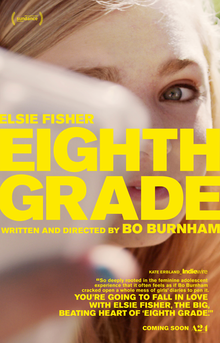
Film Review: Eighth Grade

"If You Grow Up To Have A Daughter Like You, She Will Make You So So Happy. Being Your Dad Makes Me So Happy..."


Entering into the realm of cinema after a successful career in comedy on both the online format and stand-up circuit, the Massachusetts born, Bo Burnham, delves deep into the coming-of-age genre with his directorial debut, Eighth Grade. Already critically lauded before general release after a successful round on the festival circuit, Burnham's movie concentrates solely on the youthful inexperience of Elsie Fisher's (Despicable Me 2) Kayla Day, a social media obsessed, anxiety ridden loner who in her transition from middle to high school attempts to blend herself into the ruthless ways of popularity, building new friendships, new enemies and traversing through new experiences as she does. Following on from Jonah Hill's own directorial debut in the form of the excellent, Mid90s, and released under the ever-improving reputation of A24 Films, Eighth Grade follows a very familiar genre narrative in the ilk of recent examples such as Lady Bird and The Edge of Seventeen, but unfortunately fails to hit the lofty heights of either thanks to a sluggish pace, a complete lack of anything fresh to say in an already crowded genre, and for some unknown reason, a infuriating lead character whose only purpose is seemingly to make the audience suffer as much as possible for the entire, and simply overlong, ninety minute runtime. Sorry Bo, I really, really hated your lead character. With a vengeance. 


Whilst I am thoroughly supportive of movies which attempt to offer something fresh or exciting to a genre filled with so many recent and interesting examples, Burnham's movie tries to evoke a sense of awkwardness and teenage angst to levels beyond human control, with Fisher's performance not only directed with an annoying sense of purpose to overextend an idea to the point of insanity, but also one that I simply could not sympathise, empathise or get on board with in the slightest. With Day's isolated social and familial existence established in the first five minutes, an opening act in which Fisher's character is explored through her absolute addiction to her mobile phone, her on-off relationship with her dorky father, and a online video diary with absolutely no viewers whatsoever, the chance to move on and offer a narrative with some form of intrigue just isn't taken up, with Eighth Grade falling into If Beale Street Could Talk territory by being an independent release which looks well put together, but is strangely so tepid and dull. With critics falling over themselves to proclaim Burnham as the reincarnation of John Hughes, it's time to take a step back and realise that Eighth Grade isn't that special at all, with the character of Day fighting Jesse Eisenberg's performance as Lex Luthor in Batman vs. Superman: Dawn of Justice for most annoying cinematic character of the past decade, and when you view people physically leave the cinema half way through a screening of a movie, you know something isn't quite right. Time to watch Avengers: Endgame again. 

Overall Score: 5/10

Tuesday, 16 April 2019

Film Review: Mid90s

"A Lot Of The Time We Feel That Our Lives The Worst, But I Think That If You Looked In Anybody Else's Closet, You Wouldn't Trade Your Shit For Their Shit..."


Acting as the first of two independently released coming-of-age dramas this month under the umbrella of the increasingly impressive A24 Films, a film company responsible for backing recent cinematic classics including Moonlight, Under the Skin and Hereditary to name a few, Mid90s sees Hollywood star, Jonah Hill (21 Jump Street, The Wolf of Wall Street) move from in front of the camera to behind it, working off of his own personalised script which sees Sunny Suljic (The Killing of a Sacred Deer) as thirteen year old, Stevie, a repressed, overly quiet teenage inbetweener who finds solace away from his violent and complex home-life in a group of skateboard loving misfits with a tendency for underage parties, drinking and other anti-social discrepancies. With Greta Gerwig's masterful, Lady Bird, a film also released under the banner of A24 Films, the contemporary benchmark for the modern coming-of-age story on film, Mid90s takes a very familiar if surprisingly low-key approach to the age-old tale of troubled youth, but with a convincing sense of grungy realism and a superb central performance from one of Hollywood's rising stars, Hill's movie is a thoroughly engaging and emotionally stimulating ninety minute character piece which acts as an excellent kickstarter to Hill's career as a director. 


Shot entirely with a 1.33:1 aspect ratio and on 16mm film, a cinematic technique used also on Darren Aronofsky's, mother!, Hill's movie takes the bold approach to come across as the most nineties inflicted movie ever, at least on an aesthetic level, with the letterbox framing and grainy cinematography actually quite startling and jarringly retro when it first appears on screen, but once the fancy gimmicks are taken in their stride, the drama takes its time to expand Stevie's character, offering glimpses into his abusive relationship with both his fitness obsessed older brother and emotionally complex and very young single mother, with the only way out in the form of his newly found band of slackish outsiders led by the charming and morally conflicted figure of Na-Kel Smith's Ray. With a variety of set pieces which tap into the self-destructive nature of a young boy's journey into adulthood, Hill ultimately chooses to portray his own coming-of-age tale as one of extreme hardship and cruelty, tackling a variety of issues including loneliness, jealousy and despair, and whilst the script does feature elements of seething darkness, the optimism and sentiment you would expect from this sort of movie does eventually fall into place come the final act, and with added excellent supporting performances from the likes of Katherine Waterston (Fantastic Beasts) and the A24 acting staple, Lucas Hedges (Lady Bird), Mid90s is a realist portrayal of youth in crisis with enough dedication from its' creator to win me over completely. Plus, the soundtrack is freakin' awesome. 

Overall Score: 8/10

Tuesday, 12 March 2019

Film Review: The Hole in the Ground

"There's Something Not Right With Him Lately. I Can't Put My Finger On It..."


Directed and co-written by Irish filmmaker, Lee Cronin, The Hole in the Ground is the latest rather well made, independent horror which may take that extra effort in order to seek out in cinemas. Co-written by first time film screenwriter, Stephen Shields, Cronin's movie follows a very familiar genre set up as we follow Seána Kerslake's Sarah O'Neill into the heart of the Irish countryside with her son, James Quinn Markey's Chris, in order to escape a slightly ambiguous previous violent relationship. On arrival to her newly purchased and slightly grotty open-air house however, Sarah nearly collides with the elderly figure of the infamous local crackpot, Kati Outinen's Noreen Brady, who begins a sudden and strange fascination with Chris, whilst the discovery of a gigantic and rather hypnotic ever-moving sinkhole in the heart of the neighbouring woods results in Sarah soon seeing sudden changes in the behaviour of her son whose move to the countryside seems to have made him a completely different person. 


Whilst the movie begins with an a-typical horror narrative, Cronin's movie manages to sustain from the offset a brooding sense of melancholia and smouldering darkness, personified nicely by the swaying, isolated wilderness of the woods which reside next to Sarah's new home. Whilst my own personal xylophobia means that every film which ventures into wooded area is guaranteed to creep me out, the best parts of The Hole in the Ground is when the movie embraces its' inner The Blair Witch Project or The Witch, particularly one set piece in which the camera decides to show a midnight stroll through the eyes of Sarah, with the only source of light coming from her low powered torch. As the movie moves into a third act in which seems to take nods from the likes of The Omen and other paedophobia heavy horrors, the drama does unfortunately become slightly silly, with ambiguity being thrown completely out the window and the narrative instead choosing to go down a more fantastical, mythical route as it reaches a nicely wrapped up conclusion. Whilst not memorable in the slightest or a movie which can safely stand up and say that it offers anything which can be classed as new or original, Cronin's movie is a fairly enjoyable, low-budget horror which makes the most of a talented cast who embrace the material with open arms, and with a couple of set pieces which made me watch the film through the slits of my fingers, is a movie which is worth seeking out, particular for horror completists. 

Overall Score: 6/10

Sunday, 22 July 2018

Film Review: A Prayer Before Dawn

"I Got No Family, No Money, Just Give Me This One Chance, I Wanna Fight..."


Based on "A Prayer Before Dawn: My Nightmare in Thailand's Prisons" by ex-con and former drug addict, Billy Moore, Jean-Stéphane Sauvaire's debut, high profile release elbows its' way into cinemas this week, dragging along with it a bruising sense of harsh realism and the full-blooded nightmare of Moore's journey as he is incarcerated within the confines of a Thailand prison for drug dealing and is forced to fight for his survival in a sense both literal and dangerous. Shot on location at Nakhon Pathom Prison, a staggeringly un-hygienic mosh pit of overpopulated prisoners, both dead and alive, where violence is mandatory for staying alive and gang rape is part and parcel of being proclaimed as the weakest in the populous, Sauvaire's movie is a grueling, non-stop and overly horrific portrayal of survival which incorporates a menacing backdrop to iron over the cliches of the plot, even when the fundamental story is that of reality and not fiction, and with a standout central performance and an editing pace which works particularly well considering a complete lack of meaningful dialogue, A Prayer Before Dawn is a successful and daring directorial debut from a filmmaker unafraid to tackle the darkest tales of man and the instinct to survive, no matter the cost.


With Joe Cole of Peaky Blinders and Green Room fame playing the younger incarnation of Moore, his journey from angst-ridden junkie to dedicated fighter brings with it a frighteningly authentic physical performance, one which rivals Tom Hardy's Bronson in Winding-Refn's spectacular movie of the same name for levels of incarcerated danger, aside from the pantomime sensibility of the latter which is strikingly absent, and in its place, a much more humane and regretful character arc which develops as Moore becomes used to the ways and means of his newly found incarceration. With Cole's powerful performance resulting in every jab, bruise and serious injury being well and truly felt, it's a crying shame that the screenplay for the movie doesn't entirely hold up to similarly spectacular levels, with the path of the narrative funneling through from a run-of-the-mill prison drama in the vein of Animal Factory or David Mackenzie's equally gritty Starred Up, to a bog-standard boxing conclusion, all wrapped up within a thematic sensibility which reeks of a combination between The Raid 2: Berandal and Warrior, and as amazing as that ultimately sounds, Sauvaire's debut doesn't stamp its' foot on the equal quality of its' predeceasing familiars and is ultimately a movie saved by his stellar direction of a leading performance which demands to be visualized and lauded. 

Overall Score: 7/10

Monday, 18 June 2018

Film Review: Hereditary

"I Just Don't Want To Put Any More Stress On My Family..."


Within the pantheon of modern-day horror cinema releases, only a few since the turn of the twenty first century have truly managed to encompass the sense of true terror that only the best examples of the genre always create, and with the overly worn out "cattle-prod" franchises still continuing to be admired by particular audiences who believe horror cinema simply relies on cheap jump scares, the rare chance a particular filmmaker comes along and offers something fresh to the genre is one that should always be admired and supported. Step forward director Ari Aster, a young American filmmaker whose debut feature, Hereditary, conforms to a style of horror cinema which is as tantalising to see explored within a mainstream setting as it is genuinely unsettling and and down-right evil, a film which wears its' obvious inspirations on its' sleeve but still manages to feel both unique and original, and one with a particular ominous and uncomfortable tone which for some, may seem just too much to handle. With superb performances from its' central familial quartet, staggeringly unsettling imagery and set pieces which verge on the edge of full-throttle nightmare, Aster's big-screen breakthrough is not only a perfectly constructed movie but a masterful example of the horror genre at its' most inventive and gut-wrenching. 


Beginning in a familiar, ghost story-esque setting, the death of the Graham family matriarch brings with it supernatural stirrings, unravelled secrets and a claustrophobic sense of death's presence remaining within the confines of an Amytiville-inspired household, complete with creaky doors, unkempt attic's and tree house which emits a seething, blood-red shadow whenever occupied. With Toni Collette (The Sixth Sense) as Annie, the grieving mother of two whose skills as a miniaturist artist seem to help her cope with the sudden loss of her secretive mother, her newly found role as head of the family brings with it startling realisations about the previous pastimes of her mother as she finds solace in the hands of Ann Dowd's Joan, a similarly grieving mother figure who attempts to aid Annie through her struggles. With the screenplay beginning with a contemplation on the effect of death and the psychological power it can evoke within the human spirit in a very Don't Look Now thematic sensibility, the early ghostly imagery lays a solid foundation of skin-crawling creepiness which echoes the oddity of Personal Shopper and the horror-realism of Robert Eggers' The Witch, and with the first act fixed on developing the destructive nature of a family teetering on the edge of collapse, the cold and brooding tone of the first hour is well executed, even when at times the editing pace holds particular camera shots for just a few seconds too long.


After a powerful and stunningly played midway twist, one which leaves you in a gasping and spell-binding state of shock for pretty much the remainder of the movie, the increasing sense of dread which occurs as the direction of the action switches from ghostly chiller to full-on, teeth-rattling nightmare is simply unbearable at times in the best way horror-movie way possible, and with a staggeringly uncertain plot direction, the tension which transpires from a culmination of eerie soundtrack and imagery leaves you constantly on edge as you attempt to piece together and understand where the plot is ultimately heading. Whilst the movie does cave in at times to generic conventions which weaken its' claim as "The Exorcist of the twentieth century", particularly in its' use of the tried and tested depiction of seances, the final act of Hereditary offers one of the most genuinely unnerving and oppressive works of cinema I have ever seen, and with a final twisty resolution which obviously picks at the likes of The Wicker Man and Ben Wheatley's Kill List, Ari Aster's stunning and deliciously twisted debut is a dark and twisted assault on the senses, a horror movie for genuine horror fans and a movie which features one of the most iconic leading genre performances by Toni Collette in years. Dread it, run from it, Hereditary still arrives and stamps its' mark as the horror movie to experience this year. 

Overall Score: 9/10

Wednesday, 13 December 2017

Catch-Up Film Review: A Ghost Story

"We Do What We Can To Endure..."


Fresh from an inevitable and well deserved Oscar win for his performance in Kenneth Lonergan's Manchester By The Sea, Casey Affleck returns to the big screen alongside Carol and The Social Network star Rooney Mara in A Ghost Story, a supernatural drama written and directed by David Lowery who reunites with the duo after previously working together on the 2013 drama Ain't Them Bodies Saints. With an eerie, off-kilter sensibility, a staggeringly ambitious ideas narrative and one of the most affecting musical accompaniments of the year in film, Lowery's latest is unlike anything seen on-screen this year, a film which utilises the basic horror trope of a common haunted house movie but then manages to expand its' horizons into something which resembles closer an allegorical mix of themes which evoke everything from Terrence Malick's The Tree of Life to Denis Villeneuve's Arrival. With little dialogue and a raging art-house aesthetic, A Ghost Story is a film undoubtedly not for everyone, but for those with the patience and willingness to embrace its existence, Lowery's movie is an exquisite work of art. 


Shot in the aspect ratio of 1.33:1, or in televisual and layman's terms, 4:3, A Ghost Story follows a sheet cladded Casey Affleck who after passing away due to the events of a traffic collision, follows his unnamed wife, portrayed by Rooney Mara, throughout her life after his death, all within the confines of the dated home in which they both shared. With directory David Lowery utilising the retro and "boxiness" nature of the aspect ratio to ensure the audience understands the claustrophobic nature of the film from the point of view of Casey's spectral presence, the film utilises endless long shots and unbroken edits for the first half of the movie, including the now infamous one-shot "pie scene" and a chilly, uncertain introduction to Affleck's transition from life to death, and whilst at times the pace of the movie does begin to falter, the second half of the movie in which Christopher Nolan's Interstellar seemed to be a obvious blueprint for the direction of the narrative, concludes the film in a stunning and ambitious fashion. A Ghost Story isn't a movie which belongs on the big screen, instead, Lowery's latest is more akin to a museum piece where examination and steadiness is key to admiring its' beauty, and whilst the film doesn't hold together everything it intends to accomplish within such a short amount of time, A Ghost Story is undoubtedly an unforgettable and bold moviegoing experience. 

Overall Score: 8/10

Monday, 10 July 2017

Film Review: It Comes at Night

"You Can't Trust Anyone But Family..."


Learning his cinematic craft on the set of not one, nor two but three Terrence Malick productions including the staggeringly beautiful The Tree of Life, American filmmaker Trey Edward Shults follows on from his critically acclaimed debut, Krisha, this week with It Comes at Night, a psychological horror movie which features The Gift's Joel Edgerton in the leading role and a movie which seems to have somewhat drifted under the propaganda radar, resulting in the first time in a while in which I head into a movie having no idea or preconceptions about what I am about to witness on-screen. Whether this is an element which ultimately damages or aids a particular release, there is a sense of thrilling ambiguity being unaware of a film's direction, particularly in regards to a horror movie, and what we have with It Comes at Night is a staggeringly bleak, yet wholly effective white-knuckle thriller, one which uses its' minimalist surroundings to outstanding use and a movie which perfectly showcases the acting talents of one Joel Edgerton, an actor who seems to have found his perfect hunting ground in order to grind out the best he has to offer upon the big screen.


Set in the aftermath of an unknown, ambiguous, worldwide pandemic, It Comes at Night focuses primarily on Edgerton's Paul, the husband and father figure of a survivalist family destined to keep safe in the midst of the darkened wilderness who are suddenly forced to surrender their safety for the greater good when they come across another trio of survivors who too are desperate for survival. With a narrative edge as bleak and nihilistic as films such as The Road and even at times, The Mist, It Comes at Night is a effective mix of psychological and body horror, one which echoes a wide range of previous films from 28 Days Later to last year's The Girl With All the Gifts, particularly in regards to its' underlying notion of disease and contagion, and with cinematography which makes the likes of Seven look like a Disney movie, the jet black colour pallet adds to the ghostly air of uncertainty which embraces the viewer and leaves the audience with a sense of never really knowing where the tension is directly heading. Whilst the violence and dastardly dark plot turns result in the movie not exactly being for all audiences, for someone who loved the likes of The Witch and The Neon Demon recently, It Comes at Night is independent horror at it's most effective.

Overall Score: 8/10

Monday, 2 May 2016

Film Review: Green Room

"I Can't Die Here With You..."


Of all the previews released into my local world of cine this year so far, Jeremy Saulnier's latest splatter-fest Green Room, is by far the least publicised and most unknown entity I have ventured into seeing, being one of the few rare times in which I begin a film without an inch of prior knowledge, a rare commodity if ever there was one in this day and age of stuffed-down-your-throat propaganda-esque trailers and endless streams of publicity both on the large screen and the small. Not recognising the director's name at all until the end of the movie when my overused IMDB app was swiftly opened up, Green Room was indeed the work of a mad-man, one who has an obvious love of blood splatter B-Movie greatness, harking back to the days of grindhouse pictures, whilst having an uncanny knack of relieving tension in the most horrific of scenes with the jet-black comedy element blending seamlessly with the complete and utter carnage that occurs on-screen throughout the film's more than modest 90 minute run-time. If you can handle sharp objects, killer dogs and death, lots of death then continue to read on; Green Room is one of a kind.


Following in the footsteps of recent B-Movie blood-splatter gems such as the brilliantly comical You're Next and even last years' Marmite picture Knock, Knock, Blue Ruin director Jeremy Saulnier brings to life a fusion of punk rock sensibility to the genre, with Anton Yelchin's power quadruple being caught within a rather sticky situation after performing at a isolated Neo-Nazi clubhouse ran by Captain Picard himself, Patrick Stewart. What follows is a tension-filled gore fest with explosions of violence that can hold up against anything in its' respective genre in terms of shock value, yet the undercurrent of comedy helps to differentiate the film from being a proper downer of a movie in line with something such as Eden Lake, a movie with no laughs whatsoever, with a recurring joke about desert-island bands being particularly humorous right up to the final scene. Twists and turns, blood and guts, Green Room most definitely isn't for everyone but if you are like me and enjoy the twisted nature of B-Movie greatness, check it out. Just don't east beforehand. 

Overall Score: 8/10 


Friday, 25 March 2016

Film Review: The Witch

"Mother, I've Brought A Book, Will You Look At It With Me..?"


Wherein many believe the epitome of modern-day horror movies consist solely of long scenes of tedious boredom, offset with the occasional and wholly meaningless jump-scares, there still remains the chosen few who believe it takes a whole lot more to accomplish something of which many have failed to do over the course of the past few years in particular; make a damn good horror movie. Sure, there have been the few exceptions which break the mould with The Babadook and the best Ben Wheatley film to date, Kill List being strong contenders for scariest movies of the decade so far, yet far too many concede to the money-making formula of jumpy scares over atmosphere and plot. What a massive and overly joyous surprise it is then to have witnessed the creepy, tense, overly oppressive and deliciously dark horror that is The Witch, a stunning debut from first-time director Robert Eggers who in his quest to create a realistic tale of witchcraft has indeed created the most disturbing and terrifying motion picture in years. Watch it with caution...


After being excommunicated and exiled from a New England Puritan Church plantation, William and his family swiftly move to a new home in the realms of a forest, one in which leaves them with dying crops and strange occurrences, most strikingly, when their youngest child goes missing at the hands of a unknown entity deep in the forest. Hooked already? Good, as that's all you are going to get with The Witch, a film which indeed forces you to make up your own decisions regarding what you witness on screen whilst attempting to get incredibly deep under your skin and stay there during your pitch black walk back home, conscious of that slight movement in the corner of your eye. Although jump scares aren't the primary concern of the film, there are sheer moments of horror throughout the film's 90 minute runtime, scenes in which enlighten the director's love of The Shining and The Wicker Man, whilst the gorgeous cinematography and dark, oppressive colour palette only add to the film's sense of sheer dread. With the scariest goat in movie history at its' core, The Witch is a horror movie fan's dream. Check it out and beware... SHE'S A WITCH!

Overall Score: 9/10  


Saturday, 16 January 2016

Film Review: Room

"Hello Jack, Thanks For Saving Our Little Girl..."


Starting slightly off topic, Lenny Abrahamson's latest, Room, based on the novel of the same name by Emma Donoghue, is a strange case of reminding me of the success of Disney, particularly that of the works by Pixar, in regards to how films such as The Lion King, Wall-E, and most recently, the simply wonderful Inside Out, could take important and sometimes dark subject matters such as loss, human consumption and the development from child to adult, and present them in a fashion both uplifting and engaging for everyone no matter what their age. With Room, a film that similarly has a disturbing, twisted narrative at its' core, its' one of those rare cases in cinema in which a film brings with it an abundance of different meanings, whether it be psychological, mental, or particularly, social, and that alone succeeds in making Abrahamson's latest a riveting success, one that is both emotionally draining as well as being undeniably life affirming, a strange yet incredible combination if ever there was one.


Beginning by delving straight into the lives of Joy and Jack, the mother and son combination held captive by "Old Nick" within the less-than spacious titular "room", Abrahamson's latest begins by showing us the world in which the young Jack is all but used to, a world in which life begins and ends with that of the four walls of "room", a world in which mother Joy has had to endure ever since her kidnapping at age seventeen. From such a setup, a fundamental fear began to arise in fearing what Room could have potentially become if left in lesser hands, with it perhaps playing out in a Panic Room style thriller, one in which substance was left behind in favour of drama and thrills, yet the true winning formula of Room is in its' tendency to show the events of the film from that of young Jack, where the dark subject matter, although inherently present, is left in a somewhat ambiguous, confused state in line with our young character's state of mind, brought on by his sudden change of lifestyle and the existence of, Aladdin reference inbound, a whole new world. It is this point of view that allows the film to present a wide range of sociological and psychological problems that the all too real crime of kidnapping and captivity brings across the world. It's a film that encourages to think outside the box.


Although Brie Larson has understandably been taking all of the plaudits for her simply brilliant portrayal of the captive mother, caught between making a better life for her son in that of "room"whilst being entirely aware of the power of the outside world and its' effects it potentially could have on her young child, the film no doubt belongs to Jacob Tremblay, the nine year old actor who, in the face of an intelligent, thought-provoking script, portrays the character of Jack in sheer heartbreaking fashion, with his ability to convey the emotions of a socially-inept child, one who is simply baffled and completely frightened at the prospect of understanding the newly found world, truly outstanding. It's a performance worthy of examination from a wide range of angles, whether it be from that of one either sociological or psychological, and one that deserves all the attention it can possibly get. Tremblay's performance is one of the many talking points which results in making Room a truly exquisite experience and one that won't be quickly forgotten. Room is a film of sheer, unquestionable power and one of the strongest of the year so far in the race for Oscar supremacy. 

Overall Score: 9/10