Showing posts with label Crime Drama. Show all posts

Saturday, 7 September 2019

Film Review: The Informer

"The General Is One Of The Major Importers Of Fentanyl. We're Going After Him..."


If ever there was a movie which had me sold on the trailer alone, The Informer is exactly that. Presented as a prison crime thriller produced by the gritty minds behind the superb one-two of Denis Villeneuve's, Sicario, and the action series of the decade, John Wick, The Informer, at least on a production level, definitely had a lot going for it heading in. Helmed by Italian filmmaker, Andrea Di Stefano, an actor turned director responsible so far for the little seen, Escobar: Paradise Lost, starring Benicio Del Toro, and based upon the 2009 novel, Three Seconds, from the Swedish crime-writing team of Anders Roslund and Borg Hellström, The Informer is an English speaking adaptation which sees Joel Kinnaman (Suicide Squad, Altered Carbon) as Pete Koslow, a former decorated war veteran turned criminal who escapes the confines of prison after making a deal with Rosamund Pike's (Gone Girl) FBI Handler as part of a complicated plot to bring down the renowned Polish drug baron known as "The General". 


With a tonal sensibility which includes as many laughs as a night time funeral, The Informer presents itself upon the darker range of the thriller genre, harbouring a rather depressing nihilistic viewpoint pretty much throughout in a similar vein to the likes of Sicario, albeit a movie without the technical nuance or strange, ambiguous mystery which made the Villeneuve original so damn good. Instead, the central plot involving Koslow, his family and his role within the war between the cops and the drug dealers is too cliched and tacky to come across as anything other than mechanical, resulting in a rather aggravating sense of patting myself on the back when particular plot twists and discoveries brought themselves to the forefront of the plot without any real sense of shock or enjoyment as the entire audience could see such developments walking into the movie. Whilst Kinnaman is his usually reliable self as he plays the "wounded soldier" role which his recent past performances have all seemed to have based upon, the muddled and shallow plot doesn't allow for anyone else to particularly shine, with the likes of Pike and Clive Owen resorting to bit-part players within a plot that really could have done with a bit more umph, and whilst expectations may have been unjustifiably high heading in, The Informer is well made but boy is it bland. 

Overall Score: 5/10

Thursday, 31 January 2019

Film Review: The Mule

"I Thought It Was More Important To Be Somebody Out There Than The Failure I Was In My Own Home..."


Whilst it is always harsh to judge a filmmaker with as much pedigree as Clint Eastwood on just one movie within a career which has spanned more than half a century, the rather strange and bewildering blandness of The 15:17 to Paris last year painted a dark blot on the back catalogue of the Hollywood legend to such an extent that the release of The Mule seems to have come around somewhat without an inch of hype or expectation. Returning to the world of acting for the first time since 2014, Eastwood balances the starring role alongside his duties as director for a movie which seems to be his The Old Man and the Gun or Phantom Thread, with Eastwood, who now at the tender age of 88, potentially finding the perfect time to call this old filmmaking malarky to a close. Based on Sam Dolnick's New York Times article, "The Sinaloa Cartel's 90-Year-Old Drug Mule", an account on the latter life of Leo Sharp, a World War II veteran who ran drugs throughout the USA on behalf of the Sinaloa Cartel, The Mule sees Eastwood as Earl Stone, a work consumed elderly horticulturist whose loss of business results in him resorting to working under the wing of Andy Garcia's (Ocean's Eleven) cartel boss, a decision which quickly burdens Stone with the reputation as the most reliable, if slightly oddball, drug mule in the business. 


Featuring a screenplay from Nick Schenk, the award winning writer behind Gran Torino and The Judge, Eastwood's latest is a surprisingly low-key, thoughtful and rather traditional affair, a movie which although suffers from being rather repetitive and ridiculously predictable, benefits from a genuine sense of warmness, an element personified by seeing the aged Eastwood completely embrace and have bundles of fun with a role which without the American's gargantuan impact on the world of cinema, may not have made it onto the big screen in the first place. With the criminal element of the narrative particularly straightforward to follow from the outset, the paint-by-numbers unravelling of the plot is knowingly cliched, with the most interesting part of the movie undoubtedly the character of Stone himself, with Schenk's screenplay working best in scenes where we see Stone rebuild his local community with funds raised from his illegal pastimes and the elongated trials and tribulations faced from his family, with supporting roles from the likes of the excellent Dianne Wiest (Edward Scissorhands) adding to the overarching charmful tone which the movie exhales. Whilst bold attempts at building narrative tangents such as the inclusion of strange criminal back stabbings are indeed wholly superficial, the clearest weakness of the film is the wasted involvement of anyone connected to the law enforcement, with the likes of Bradley Cooper (A Star is Born) and Laurence Fishburne (The Matrix) not exactly being given the time or the material to offer the type of performances both are renowned for, but with a sense of technical reliability which comes with most things associated with Eastwood, The Mule won't set the world alight, but much like its' titular anti-hero, is a movie which drives from point A to B in good time without alarming anyone along the way.  

Overall Score: 6/10

Sunday, 27 January 2019

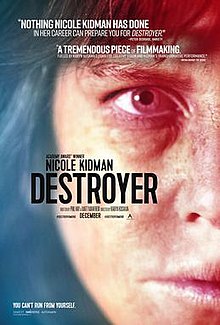
Film Review: Destroyer

"You Chose To Play Cops And Robbers. And You Lost..."


Ending the year as Queen of Atlantis in Aquaman, the ever reliable Nicole Kidman begins 2019 with a completely different and polar opposite performance as the Aussie takes the lead role in Destroyer, the latest feature from American filmmaker, Karyn Kusama, whose previous credits include the recent cult favourite, Jennifer's Body, and the all-female directed anthology horror movie, XX. Part noir crime thriller, part sanctimonious art-house reject, Kusama's latest is a particularly odd beast, a grungy, overly depressing character study which sees Kidman as LAPD detective, Erin Bell, a worn out, angst ridden alcoholic who stumbles across the death of an unidentified criminal and soon becomes entangled in a dark underground plot which sees the resurfacing of Toby Kebbell's (Dead Man's Shoes) murderous gang leader whom Bell previously infiltrated undercover many years previous. With many critics focusing on the transformation of Kidman in the lead role as the standout highlight of the piece, the fact that five minutes in I began to laugh at the awfulness of the Australian's facial stiffness probably was a strange sign of things to come, and whilst Kusama's latest features some bold attempts at greatness, Destroyer is ultimately a downbeat, overly plodding and uninspiring drama which dreams big but can only be classed as a unforgettable failure.


Utilising two different time frames to enhance and develop the background behind Kidman's character, the contemporary setting sees her manage to strike a odd balance between an extra off The Walking Dead and Johnny Depp's performance as James Bulger in Black Mass, with a gallon of rough edge makeup, a seemingly awful visit to some Sweeney Todd-esque barber and a leather jacket the standout elements of a performance which I'm sorry to report, just seems so superficial and phoney, the story just becomes irrelevant everytime Kidman appears on screen due to her image just coming off as too damn distracting. Whilst the first half of the narrative ultimately becomes too irritating to truly be engaged with, the second time zone in which we see a younger and less painted Kidman infiltrate Kebbell's stone free gang of dangerous misfits is undoubtedly the more interesting of the two, particularly with the added charisman of Sebastian Stan (Avengers: Infinity War) as her partner in both undercover and romantic sense, who out of everyone in the entire film, was the most pleasing and interesting to be around and arguably could have been the focus of the movie in the first place. Stan aside, Destroyer also sees one of the most obvious miscasting decisions this year in the form of Kebbell as the mousy haired ring leader, a character as threatening as the unicorn from Despicable Me, whilst attempts at building wavering familial relations with a strange subplot involving Bell's daughter and her asshole boyfriend fails to spark at all, culminating in a concluding monologue about parental responsibility and mountain climbing which nearly sent me straight to sleep. Ending with a Shyamalan sized twist which still has me wondering whether it was genius or actually quite ridiculous, Destroyer is one of the most depressing two hours you may spend at the cinema this year but hey, if you fancy being in the company of hateful characters for two hours, Kidman's latest may be the exact medicine for you. 

Overall Score: 4/10

Sunday, 14 October 2018

Film Review: July 22

"I Still Have Hope, Dreams, Family and Friends. And I Choose To Live..."


Based upon Åsne Seierstad's 2015 book, One of Us, a biographical account of the shocking 2011 Norway terror attacks carried out by lone wolf and far-right extremist, Anders Behring Breivik, director Paul Greengrass (The Bourne Ultimatum) returns with yet another intense and powerful cinematic adaptation of true events in the form of 22 July following on from the critically acclaimed one-two of United 93 and Captain Phillips in 2006 and 2013 respectively. Released simultaneously within a select amount of theatres and streaming exclusively and nationwide on the Netflix platform, Greengrass' latest is a stark, relentless and brilliantly acted attempt at highlighting on the one hand the sadistic, evilness of terror, and on the other, the power of unity and strength within a community riddled with tragedy and extreme loss, and whilst 22 July contains elements which rank up there with the most intelligent, albeit harrowing, works of cinema produced by Greengrass thus far in his rather exceptional back catalogue, the film as a whole fails to handle the subject matter with enough conviction to really scratch the surface of understanding the purpose of such despicable acts or the lingering effect it had on the wider populous, a particularly aggravating weakness considering such themes are ones the Greengrass undeniably knows how to convey when dealing with such tragic, contemporary events. 


With an agonsing and exceptionally difficult opening act in which we observe in documentary-like style the plans of Anders Behring Breivik fall into place, Greengrass chooses not to hide away from the violence carried out but also thankfully slides away from falling into the trap of over-sensationalising it too, with the first forty minutes at times simply unbearable as the camera follows Anders Danielsen Lie's (Personal Shopper) portrayal of Breivik as he increasingly and coldly murders his way through innocent lives in order to satisfy his political beliefs. After releasing the audience from the clutches of terror come the hour mark, the remaining ninety minutes is spent observing key characters in the events leading up to Breivik's trial, ranging from Jonas Strand Gravli's wounded young survivor to Jon Øigarden's portrayal of Geir Lippestad, the lawyer tasked with defending Breivik, and whilst Greengrass attempts at balancing the narrative to focus on the wider effect of Breivik's actions, the pacing and lack of depth results in the movie unfortunately sliding into a manner which can only be described as overly procedural and shockingly, rather plodding. Where the movie does ultimately work however is in the emotive-laden set pieces and concentration on the singular rather than the many, particularly a concluding court speech from Gravli's broken terror victim, and whilst Greengrass carries out the drama in efficient means, for a movie verging on two and a half hours worth of storytelling, July 22 struggles to justify such enormities and fails to hold the sheer starkness of a simply masterful opening act. 

Overall Score: 7/10

Monday, 23 July 2018

Film Review: Hotel Artemis

"We've Been Here For Twenty-Two Years. This Hospital Was Built On Two Things: Trust And Rules..."


Written and directed by British filmmaker, Drew Pearce, whose previous credits include screenplays for the likes of Iron Man 3 and Mission: Impossible - Rogue Nation, Hotel Artemis features a generously stellar cast set as they are whacked slap band in the middle of a dystopian riot zone and forced into the titular, secretive building where entry is gained for members only and is ran with strict rules and regulations by Jodie Foster's (The Silence of the Lambs) Jean Thomas AKA The Nurse. With flashes of neo-noir crime drama and a underlying, wacky black comedic sensibility, Pearce's movie is a strange, tonally manic mess of a movie which sacrifices plot for excruciatingly annoying characters and a narrative through line for dull set pieces, all taking place within a set location which seems to have forgotten to pay the lighting bill, and whilst Pearce in the past has worked alongside the likes of Shane Black, a filmmaker renowned for making dark comedy work successfully, Pearce's debut doesn't take any tips from his cinematic learning curve and is unfortunately a painfully dull and excruciatingly boring waste of ninety minutes in which stuff just happens without any sense of reason or point.  


With an opening backdrop which introduces a future-world Los Angeles in which privatisation of the area's water supply has sparked mass rioting and protest from the lower class of the populous, Pearce's movie follows Sterling K. Brown's (Black Panther) Waikiki after a bank heist gone wrong forces him into the Hotel Artemis, an off-the-books NHS for the criminal underworld which reeks heavily of The Continental Hotel influence from the John Wick series. Cue the introduction of Jeff Goldblum's (Thor: Ragnarok) The Wolf King, who seeks vengeance for the theft of his multi-million dollar priced jewels, and soon the action and violence breaks loose, resulting in the likes of Dave Bautista (Spectre), Zachary Quinto (Star Trek) and the ever radiant Sofia Boutella (Atomic Blonde) all flexing their action muscles in an attempt to overshadow their meaningless characterisation. With Charlie Day (Pacific Rim: Uprising) once again proving to be the most annoying Hollywood actor currently employed, Hotel Artemis fails on a fundamental movie-making level by not only lacking a straightforward central narrative, but also a movie which doesn't manage to be at all accessible or believable, and by the time the movie crawls its' way to the finish line, it almost felt heavenly to leave the seat in which I had been violently squirming in for the preceding ninety minutes. 

Overall Score: 3/10

Sunday, 4 February 2018

Film Review: Den of Thieves

"Keep Your Eyes Open. Every Cop In The Country Is Going To Be Looking For Us..."


Being an avid hater of most things which bear the name Gerard Butler in the closing credits, the release of Den of Thieves unsurprisingly accompanied a heavy sense of sadness at potentially spending yet another two hours sat in a screening which results in time ultimately being well and truly wasted, and with London Has Fallen screenwriter, Christian Gudegast, on directorial duties for the very first time in his career, it's not exactly hard to imagine why on entering the auditorium in preparation for Gudegast's movie, my heart became just a tiny bit heavier. Whilst I'm more than adjusted through years of movie-going experiences to sometimes accepting and devouring a slice of humble pie, Den of Thieves is unebelieavably the sort of movie which raises above the sordid expectations set upon it in a somewhat miraculous fashion and leaves you shamelessly declaring out loud how wrong you were in the first place, a movie which presents itself as a slick, if sometimes silly and overly cliched, action romp which although is nothing entirely original or groundbreaking, still manages to be a worthwhile trip of high octane guilty pleasure. Praise the lord, we have a miracle. 


Focusing on two teams either side of the law, each with their own questionable moral compasses and a penchant for steroid infused workouts, Den of Thieves undeniably pays a significant homage to Michael Mann's 1995 crime masterpiece, Heat, in more ways than none, with the narrative essentially switching Al Pacino for Gerard Butler (300) and Robert De Niro for Pablo Schreiber (Orange Is The New Black), and whilst on paper such a switch seems similar to swapping Ferrari for Nissan, Gudegast's penchant for style and solid eye for action set pieces and well orchestrated heist scenes means that within a overly similar tale of cops and robbers, the debutante's movie packs a significantly entertaining punch and manages to hold your attention throughout its' bulky two and a half hour runtime. With Butler actually managing to not be entirely god awful, with even the staggeringly underplayed bad boy lifestyle in which his character partakes failing to undermine his performance, and the rest of the high profile cast including O'Shea Jackson Jr. (Straight Outta Compton) and Curtis "50 Cent" Jackson (Southpaw) all giving a solid case for their inclusion, Den of Thieves is undoubtedly one of the surprises of the year, and even with a "I gotcha!" style ending which wouldn't have gone amiss in Hustle, Gudegast's movie is actually pretty darn good, and for someone who was sharpening their knife going into it, that's damn fine praise indeed. 

Overall Score: 7/10

Monday, 1 January 2018

Film Review: Molly's Game

"You Managed To Build A Multi Million Dollar Business Using Not Much More Than Your Wits..."


The first film of 2018 has swiftly arrived and brings with it the talented presence of writer/director Aaron Sorkin whose screenplays for the likes of The Social Network, Moneyball and Steve Jobs have placed him at the top of many's list for the most in-demand screenwriter in America. Turning to the director's chair for the very first time, Sorkin utilises the prestigious talents of Jessica Chastain in a dramatic representation of Molly Bloom's autobiographical memoir about the rise and fall of her independently managed luxurious poker empire and the subsequent legal battles following the fallout of a statewide led criminal investigation. With Sorkin's recognisable literary craft sweeping throughout, Molly's Game is a rigorous exercise of the American's unmistakable style audiences have grown to respect and love, and whilst a lengthy and bloated narrative timeline does weaken the finished product and prevent the movie being held in the same esteem as previous Sorkin penned releases, Molly's Game is a flashy full house of a movie with a Chastain on unmissable form. 


Beginning with a quickfire introductory voiceover outlining a young Molly Bloom's disastrous Olympic skiing experience, Sorkin's narrative weaves its way sharply and smoothly throughout a first act which follows Chastain's Bloom as she develops from wandering idealist to opportunist successor, one who uses her real estate agent contact (Jeremy Strong) to flex her intellectual muscles and take over control of an infamous and highly prestigious unlicensed poker ring. With the money flowing, the famous faces increasing and a drug addiction mounting, Sorkin's script attempts to mix in a wide range of elements of both a personal and dramatic nature of which the source material may have successfully delved into on paper, but even with a two and a half hour runtime to play with, these multiple plot threads do end up feeling convoluted come the final act where even the addition of a ever reliable Idris Elba does strangely seem somewhat added on, with his character never really having the depth to solidify his existence. However, with Chastain owning a leading role which carries all the charisma and charm you would expect from an actress renowned for playing similar characters in Miss Sloane and Zero Dark Thirty, Molly's Game is a zippy and smart character drama which excels thanks to the involvement of a writer whose move to directing has began more than rewarding. 

Overall Score: 8/10

Wednesday, 12 August 2015

TV Review: True Detective - Season Two Episode Eight "Omega Station" SPOILER ALERT

A Truer Detective?


This week brought an end to the second season of Nic Pizzolatto's highly addictive crime sage True Detective, a show that this year has been rife with criticism and finger-pointing with many arguing that aside from being wholly unsubstantial to its' predecessor, it has also been an utter disaster with many being critical of its over-elaborate plot, cliched characters, and the ability of lead-writer Pizzolatto who has come under much scrutiny for this season's attempt to diverge from the occult-ridden themes of the first and move into a noir-fueled epic, featuring a bundle of new characters and a range of different plot threads in order to make up its' eight episode run. In terms of my own personal viewpoint on this season of True Detective, I am seemingly one of the few in believing that this series offered the opportunity for Pizzolatto to expand his horizons in regards to what can be achieved with such a format that True Detective holds, resulting in a season that yes, did have a wide range of flaws and weaknesses, but was also highly enjoyable with moments of sheer greatness which distinguished itself from anything else on TV at this particular moment of time. And I salute it. 


In a rather ironic sort of way, "Omega Station", the concluding episode of this years' series, pretty much epitomised everything that True Detective stood for this time around, with the beautiful cinematography, including the wonderful overhead shots of California's vast landscape, and heart-pounding scenes of tension, particularly in regards to Velcoro's tragic last stand, being the highlights of the episode. These particular highlights were traits that although were absent slightly from the first three episodes of the series in which time seemed to go rather slowly with not much actually happening in regards to the overall plot, came to form the basis of the second half of the series in which the story finally managed to take a step forward, resulting in the last three episodes of the series being undoubtedly the best in a string of episodes that began with a drag yet concluded with an almighty band. And what a bang it was. If Frank and Ray's raid on Agranov's cash deal wasn't thrilling enough, "Omega Station" left us with a range of memorable scenes, ranging from Velcoro's redemption to Semyon's hallucinatory last-breath, something of which was straight out of the Lynch-school for dramatic weirdness.  


 In typical noir-esque fashion, the fate of our three heroes in this years' season, as well as Vince Vaughn's Frank Semyon, was rather depressing to say the least, with only Rachel McAdam's Ana Bezzerides coming out alive, albeit on-the-run from the corrupt power structure that has overtaken our beloved heroes' home, following the now-famous Game of Thrones policy that sometimes that bad guys have to win. In regards to out main band of heroes, it was obvious that Colin Farrell's Ray Velcoro was indeed the most interesting of the bunch, with Farrell's acting being on top-notch from the start, whilst Vince Vaughn must also take credit for embodying a role which so easily could have gone majorly wrong due to Vaughn's capacity for cringe-worthy comedic acting, yet ended up being one of the better points of this years' season resulting in a true sense of redemption for an actor so easily laughed at for his involvement in a string of rather questionable movies more recently. So, where did it all go wrong? In my own opinion, most of the backlash in regards to this years' series simply came from people jumping on the True Detective-bashing bandwagon, with it seemingly being hip and cool to add to the growing list of haters for this years series, whilst many simply couldn't deal with the fact that this years' series was nothing at all like the first, something of which I was impressed by, with this season offering a truer and more down-to-earth take on the crime genre than the occult-ridden themes of the first.


But in all my fondness for the series, there were noticeable weaknesses and missteps, no more so than the ear-gratingly bad dialogue that our characters spoke at particular moments of the season, with our heroes' hatred of E-Cigarettes being a personal favourite whilst Semyon's attempt at being his own personal Gandhi with cringe-worthy anecdotes and "inspirational" speeches being draining at times, highlighting that perhaps all the critical praise Pizzolatto received first time around slightly going to his head. Also on the weaker side was the rather messy plot lines that although were rather hard to follow at times, also resulted in a sense of hollowness during the revelation of Caspere's true murderer, which, in the end, was wholly anti-climatic and had only a slight relevance to the messy plot lines regarding corrupt police officers and business officials which Pizzolatto felt compelled to tell us about. But hey ho, I'd rather watch a series with flaws and weaknesses than anything else if that particular series has as much entertainment value as True Detective undoubtedly has. At the end of the day, Nic Pizzolatto's crime sage may not have been for everyone this time around, but for me it was wholly refreshing and gave me a reason to wake up early on a Monday morning, and for those reasons alone I am going to miss it. I can only hope for Season Three this time next year.

Episode Score: 9/10

Overall Season Score: 8/10


Wednesday, 5 August 2015

TV Review: True Detective - Season Two Episode Seven "Black Maps and Motel Rooms" SPOILER ALERT

Death 'Til Us Part


With the complex and sometimes baffling plot threads, questionable dialogue, and a desire to try and out-class its' critically acclaimed predecessor this season, True Detective Mark II has had a wide range of detractors and naysayers, yet this weeks' episode proved that when done correctly, True Detective has the fundamental genetic makeup to be a true great within the already brilliant HBO lineup whilst having the potential to match and rival anything on TV all across the globe. This weeks' penultimate episode featured everything that made True Detective what it was last year with an increased level of threat and danger towards our main three heroes, solid acting from all involved, and twist and turns that solidified my anticipation for the concluding episode next week in which we are set to tie together the many loose ends that have been left by the complex nature of the overarching plot-line regarding the death of Ben Caspere. This week also handed us the first taste of death for one of our "True Detectives" with Taylor Kitsch's Paul Woodrugh violently biting the dust at the hands of Ray Velcoro's police chief. Lieutenant Burris, after narrowly escaping a confrontation with his blackmailers, all of whom seem to be privy to the events of last week's drug infused orgy in the hillsides. 


With Kitsch's Woodrugh off  the payroll, one man who took the lead with some panache this week was Vince Vaughn, who although at times hasn't had the best writing to work with, particularly in regards to his sometimes ear-grating dialogue, has proven to be one of this highlights of the season with this week's episode allowing him to fully embrace the deceptive and seedy nature of Frank Semyon who once again escaped from bleeding out entirely and instead remained firmly on the ropes after destroying his two clubs after acknowledging the power struggle between him and Russian gangster, Osip Agranov. Following suit, Detectives Bezzerides and Velcoro also felt the heat this week by both turning to the other side of the law after a turn of events in which their one trusted source within the law department was found dead in their car with the blame firmly placed in the lap of Velcoro. With the walls falling in around our three remaining leads, next week's conclusion of this year's season of True Detective is one that shouldn't be missed. See you then. 

Overall Score: 9/10


Wednesday, 29 July 2015

TV Review: True Detective - Season Two Episode Six "Church In Ruins" SPOILER ALERT

Risky Business


Due to an enormous level of work and cinema constraints (Damn you Inside Out!), my rather punctual review of the week's episode of True Detective has annoyingly come two days too late, but nevertheless, such a time period has allowed me to fully digest "Church In Ruins", an episode in which events within the personal and overall plot-lines of our main heroes and heroines took a step up in an attempt to ready us for the roller-coaster ride that hopefully will be the series' two concluding episodes. If one overall positive thing is to be taken away from this years' series of True Detective, it is undeniably going to be Colin Farrell, who's performance as troubled cop Ray Velcoro hit top-notch this week, particularly during the scene in which we relentlessly witness his descent back into drugs and drink in order to fully accept the notion of losing his son once and for all. On the opposite side of the law, Vince Vaughn continues to impress as Frank Semyon who continues to try and progress in his own investigation into the death of Ben Caspere whilst once again feeling the pressure from the depths of the criminal underworld with the return of the eerie, if rather out-of-place, sombrero wearing Mexican. 


As for Detective Bezzerides, wow. The concluding scene in which we witness one of the weirdest undercover operations ever was not only difficult to watch in some places, but also brilliantly executed within all the madness and endless sexual intimacy that was presented on-screen. Kudos too to Bezzerides' for her ninja skills in the inevitable, yet rather cool and badass knife-attack in which we finally see her expert knife-wielding tactics being but to good use. Oddly enough, with all the attention firmly on Velcoro and Bezzerides this week, Taylor Kitsch's Paul Woodrugh decided to take a step back this week from the limelight and oddly enough, brought about a much better episode, with his own personal storyline definitely being the weakest of the trio's throughout the series so far, yet his looming one-two of marriage and fatherhood may be the cause for his troubles to have finally stopped. This week's episode of True Detective therefore definitely produced a high watermark for the series, propped up by Farrell's magnificent performance and a scintillating final scene in which the bones of the overall storyline just got a little bit juicier. 

Overall Score: 8/10 


Monday, 20 July 2015

TV Review: True Detective - Season Two Episode Five "Other Lives" SPOILER ALERT

Aftershocks


With the bloody, gunshot ridden conclusion that rounded off last week's episode of True Detective, this week's venture into Nic Pizzolatto's noir-crime drama was bound to deal with the consequences of such, particularly in regards to the surviving trio of Velcoro, Bezzerides and Woodrugh who witnessed first hand a barrage of death and destruction. After a weird and ambiguous change to the show's theme tune to start us off with, such consequences of the shootout are swiftly distinguished within "Other Lives" with Velcoro and Bezzerides seemingly ending up with the short change, with the latter now working under Frank Semyon and the former ending up in storage, whilst Woodrugh has seemingly taken all the plaudits and rewarded with the opportunity to have a go at being Detective. Of course being only halfway through the series, the fact that both Velcoro and Bezzerides are now out of the main picture, it has given them a chance to establish, low key, other inquiries into the ever-confusing death of Ben Caspere, much to the enjoyment of every True Detective fan with this particular episode diving deeper into the seedy backstory into his death, including a rather nasty looking hut with a rather bloody look to it in a scene that bears similarities to that of the first series. 


Elsewhere, Frank Semyon attempted to reconnect with his human side in an attempt to rekindle his relationship with Mrs. Semyon whilst Velcoro was asked to look into his personal staff in an attempt to detect the blame in regards to his loss of finance which followed the death of Ben Caspere. With Velcoro well and truly under the thumb of Semyon, the rather shocking twist regarding the true fate of his wife's rapist brought the episode to a mouthwatering close, in a confrontation that will ultimately have heavy repercussions heading into the final few episodes. With all the negativity regarding the snail-esque pace of this season's main storyline, "Over Lives" fought back with a bang and offered a chance to delve deeper into the lives of all four of our main protagonists whilst moving forward with its' underlying through point regarding the death of Ben Caspere at a rate which finally is leading Season Two of True Detective into a direction it deserves to be heading in. 

Overall Score: 8/10


Monday, 13 July 2015

TV Review: True Detective - Season Two Episode Four "Down Will Come" SPOILER ALERT

To Live and Die In L.A


With the first series of True Detective declaring it's sheer awesomeness during its' fourth episode when we were treated to the now-famous one-take, gang-land escape scene, this week's episode of series two was bound to include some sort of monumental set-piece in some form or another. And boy, wasn't it just? The explicitly violent massacre that concluded "Down Will Come" not only was shocking as it was bloody, but also featured ten minutes of ramped-up action that had been absent from this season so far, concluding with Officers Velcoro, Bezzerides, and Woodrugh physically repelled at the sheer carnage they had just all witnessed after a search and seizure on a potential suspect was turned completely on its' head. Although such a scene was downright epic in its' own right, parallels to the first series was inevitable. regardless of how good such a scene was going to be, yet I think it's time to move away from comparisons to the first series and just enjoy True Detective for what its' attempting to be this year; a dark and brooding noir crime thriller that is trying it's hardest to shake off the plaudits of its' predecessor by not being just more of the same. 


Of course, the argument that its' attempting to not be "more of the same" can be easily criticised due in part to the way in which such a set piece in this week's episode was pretty much expected, but on the whole, the concluding shootout worked and I believe if such a scene was placed into another, bog-standard crime show, it would be applauded. I know True Detective, you just can't win. Although the final scene was something to take away from this week's episode, in terms of the overall plot, not much was entirely expanded upon, with Frank Semyon still attempting to rebuild his legacy in the crime underworld, whilst the depth of the case was only focused on within the last ten minutes or so, aside from some rather confusing plot lines regarding spiritual seminars and land development, making this week's episode memorable in places, but overall, just filler in the overall context of the seasons overarching plot threads. 

Overall Score: 7/10 


Monday, 6 July 2015

TV Review: True Detective - Season Two Episode Three "Maybe Tomorrow" SPOILER ALERT

May The Elvis Be With You


Last week's episode of True Detective left us questioning whether the series had accomplished one of the most shocking deaths of recent times with the supposed murder of Detective Velcoro, a character portrayed majestically by everyone's favourite Irish export Colin Farrell, yet such a mystery was immediately resolved in the first few minutes of "Maybe Tomorrow" when we established that the murderous bird-masked assailant had thankfully decided to load his shotgun with rubber bullets, much to the relief of Velcoro himself as well as most viewers I would assume who, like me, see Velcoro as one of the more interesting characters in this years' series. One negative aspect of such a quick resurrection however was that all the fun and games of playing that one scene over and over in the week between the two episodes was quickly overshadowed with such an attempt on one of the leading characters life being brushed over rather instantaneously, a major shame in my opinion. Top marks however for the obvious Lynch/Twin Peaks inspired dream sequence that kicked this week's episode off though. A good, retro, Lynch reference is always going to win me over. Well done. 


With Velcoro's swift resurrection, "Maybe Tomorrow" marched swiftly forward in an attempt to speed up the rather rambling plot lines that are starting to materialise, with the editing in this particular episode flying like a steam-train in order to keep us privy to not only dealings within the police force, but out of it, with Frank Semyon finally unleashing his inner evil after seeing one of his henchman being brutally murdered in manner not too dissimilar from that of Ben Caspere (Were his eyes not removed?). Furthermore, the obvious symbolism of sexual incapability between the two leads of the series in both Semyon and Woodrugh ties into the notion of both seemingly being absent from what they desire most, with Semyon reeling from the notion of leaving the criminal enterprise and Woodrugh's obvious defiance from "coming out" as it were. This undercurrent sexual motif has been highly recurrent in this series so far, making me question whether lead writer Nic Pizzolatto is purposely fleshing out characters with such vices in order to have not one, but a whole range of potential suspects for the series' main mystery on both sides of the law.


Weaknesses of the episode followed suit of the series' overall weaknesses so far, with a few more examples of cringe-worthy dialogue, whilst the shallow, caricature-ridden portrayal of Mayor Chessani 's family, including his trophy wife and extremely annoying son was rather laughable in places. Furthermore, what is everyone's problem with E-Cigarettes? I mean come on, there are much worse problems out there. In conclusion therefore, True Detective once again supplied another solid and intriguing slice of gritty, noir-esque mystery, stifled with sex, drugs and rock 'n' roll, a winning recipe if ever there was one, if suffering from questionable dialogue and an all-too-quick resolution to the cliffhanger of the previous episode. 

Overall Score: 8/10


Monday, 29 June 2015

TV Review: True Detective - Season Two Episode Two "Night Finds You" SPOILER ALERT

Shotgun Blues


Wow. HBO has officially become the number one slaughterhouse for main characters in any of its' many series, with the final scene of this week's True Detective episode seemingly killing off Colin Farrell's conflicted cop character, Detective Ray Velcoro at the hands of the same masked murderer (The Birderer as it were) who was seen driving the deceased corpse of Ben Caspere. This is HBO however, and in a similar vein to the death of Jon Snow in Game of Thrones, the death of Velcoro just seemed rather strange, if rather shocking, due to fact that not only was he undoubtedly the most interesting character on the show so far, but his storyline was slowly expanding into something much deeper and darker which was ultimately the backbone of the season so far. With this in mind, the fact that Velcoro took the bulk of his killers' shotgun blasts to the chest suggests that death may not be the outcome of such a tragic event, but hey, I assume we will find out in the near future. 


"Night Finds You" also began to expand on the death of City Manager Ben Caspere, starting with the autopsy in which our trio of heroes were subject to not only being told he was privy to an STI or two, but to be shown the remains of his John Thomas which had been blown to shreds by a shotgun (eh, ring any bells?). Also on the agenda of Caspere's death was the financial game of cat and mouse he was supposedly playing with Vince Vaughn's Frank Semyon, with Caspere refusing to invest Semyon's livelihood in a field of industry swaying more towards the legal side of business than anything perhaps Semyon has encountered before. With money the hot topic on Semyon's mind, Caspere's death subsequently has sent him on his own personal investigation into his murder with the location in which Detective Velcoro was shot being one in which Semyon had found on his own accord. Was it just by accident that Semyon sent Velcoro to his supposed doom or was it in fact intended, with Velcoro's reluctance to continue playing puppy dog to Semyon's demands being the only justification for such that I can think of. 


Episode Two in this season of True Detective definitely explored much more ground than the previous in regards to the main story arc that will be focused on in the coming weeks, with greater character development of our heroic trio being greatly needed, whilst suffering once again from some cringe-worthy lines of dialogue (Velcoro's speech in which an E-Cigarette was seen as a robot's penis springs to mind) that endanger it into falling into a satire of its' own existence. The final scene will get the headlines undoubtedly, but I believe the death of one of the series' most interesting characters is a decision come way too soon and will subsequently be sorted out in the coming weeks but hey, this is HBO, anything could happen. 

Overall Score: 9/10


Monday, 22 June 2015

TV Review: True Detective - Season Two Episode One "The Western Book of the Dead" SPOILER ALERT

Vice City


With Game of Thrones over for another year at least, HBO has delightfully helped us deal with the death of Jon Snow by rewarding us with the return of the brilliant True Detective, albeit with a completely different cast and story to the first season which featured Matthew McConaughey and Woody Harrelson as its' lead stars. Replacing them in the lead roles of Season Two is the equally brilliant Colin Farrell (Phone Booth, In Bruges) and the less-than remarkable Vince Vaughn (Swingers, Dodgeball) who has decided to play against the stigma of his highly associated comedic roles and embrace the darker side of his acting ability. With True Detective running for a solid eight-week run, I will be doing weekly reviews of HBO's highly engaging crime drama and conclude with an overall season score. The first thing to say about Season Two of True Detective is that it has a high threshold to follow after the critically acclaimed first series, yet the first episode has presented some promising, if rather familiar, story arcs to settle down into over the course of its' two month run. 


Of course, acting as an anthology of stories per season rather than a continuation of character arcs and plot-lines, Season Two was inevitably going to begin by highlighting some in-depth characterisation of the key players in this years' storyline. Within "The Western Book of the Dead" therefore we are introduced to characters on both sides of the law, with Colin Farrell's troubled Detective Ray Velcoro arguably having the most interesting on-screen presence, solidified by the performance of Farrell who manages to sway the character of Velcoro away from the stereotypes of the corrupt cop into a much deeper and darker ground.  The scene in which he faces his "child's" bully was quite startling, if rather OTT to say the least, but the sheer range of emotions Farrell managed to cruise through in a single scene was evidence of what a great leading actor True Detective has once again managed to bag. Of course the hyphenated use of "child" signified my first response to seeing Ray's "son", yet the plot thread of knowing that he may have been born out of rape only adds fuel to the fiery rage of one of this seasons' most interesting characters already. 


Also on the side of the law is Officer Paul Woodrugh (Taylor Kitsch) and Detective Ani Bezzerides (Rachel McAdams) who follow in the footsteps of Velcoro in each having their own particular vices, suggesting that the trait of the damaged cop is particularly ripe in the state of California, yet vices aside, the entirety of "The Western Book of the Dead" pretty much offered backstory to these three core characters, with the final scene highlighting the main plot thread for the series and conjoining the trio together for the first time. On the opposite side of the law, Vince Vaughn's Frank Semyon offered a point of view from the criminal enterprise which is set to offer a much more in-depth and layered insight into the main story arc of the series by having characters that we may possibly root for on both sides of the law. True Detective can also offer redemption for Vaughn as an actor with a much more serious and darker role offering the chance to rescue Vaughn's career from sliding off into the depths of despair and from the small screen-time we had with his character, it seems it may be slowly being saved. 


"The Western Book of the Dead" therefore offered plenty of backstory for the characters of True Detective Season Two, whilst leaving us with a final scene which established the core plot thread for the series in which murder mystery is set to be rife once more. With a strong cast heading the bill once again, True Detective is set to offer two months of engaging entertainment and compelling drama. HBO, we salute you.

Overall Score: 8/10


Friday, 19 June 2015

Film Review: Mr. Holmes

True Detective


The world-renowned image of one Sherlock Holmes is now hotly, and justly, associated with Mr. Cumberbatch who has taken the popularity of Arthur Conan Doyle's detective to obscene levels of popularity in the 21st century. It is only apt therefore for an actor of status such as Sir Ian McKellen to add a further level of depth to an already well-established character on the big screen, with Mr. Holmes delving into the later life of the great detective, who aside from struggling from the normal growing pains of memory-loss and tiresome limbs, struggles too from the pain of a long forgotten case whilst simultaneously finding redemption in the form of young apprentice, Roger, played by newcomer Milo Parker. If the BBC production of Sherlock can be aligned with traits of being both fast-paced and highly engaging, then Mr Holmes can be seen as a much more mellow and somber affair with the primary action taking place in jump cuts to actions that have previously occurred. The fact that young Roger himself continually asks Sherlock to try and recollect such previous encounters, thus echoing my own feelings, suggests that the filmmakers are well aware of the need to hurry up and get to the highly engaging flashbacks which deeply overshadow the less than captivating moments in which we see Sherlock attend to his apiary.  


Based upon "A Slight Trick of the Mind" by Mitch Cullin, Mr Holmes does feature a stunning lead performance from one of cinema's most beloved actors in the form of Sir Ian McKellen, who embraces the chance two-fold to portray the great detective himself, whilst young Milo Parker and Laura Linney provide solid enough support as mother and child double act. Although the film flew by and had just enough entertainment to keep me engaged throughout, fans of the Cumberbatch era Sherlock may be unhappy with the lack of overall Sherlockian mystery that Mr. Holmes presents, yet the film does not shy away from the fact that instead of just another big-screen adaptation of such, Mr. Holmes intends to show an older and more fragile side to the detective that we are used to and for that, I applaud it. 

Overall Score: 8/10